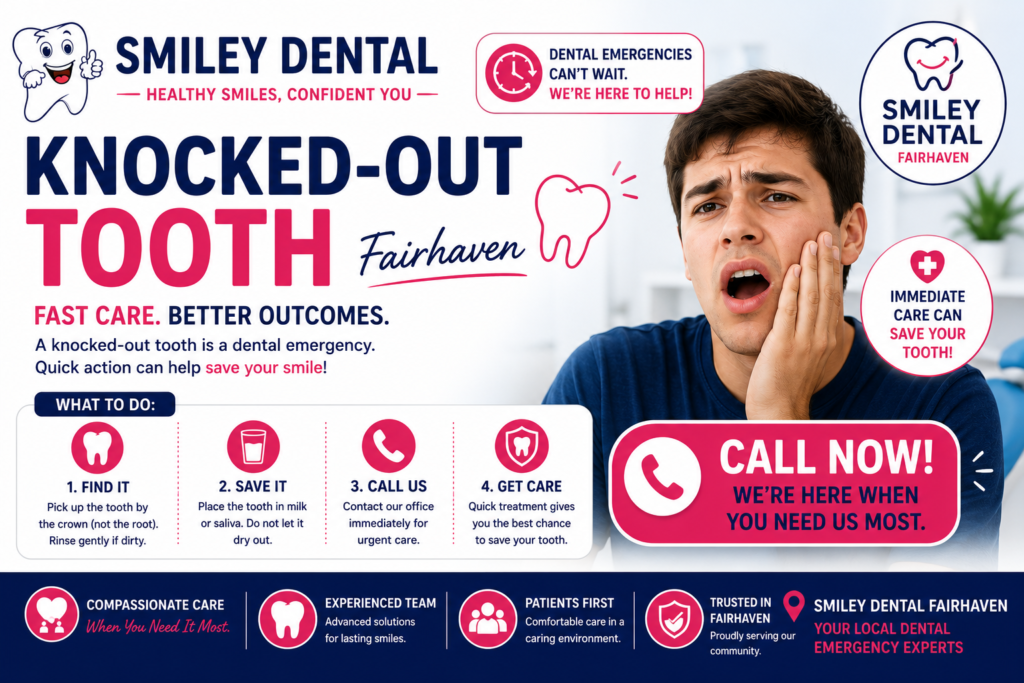
Pick the tooth up by the crown, never the root. If it is dirty, rinse it for a few seconds in milk or saline, then try to slip it back into the socket and bite gently on clean gauze. If you cannot replant it, keep it in a cup of milk. Then call an emergency dentist right away. Being seen within the first hour gives the tooth its best chance of survival.
A tooth knocked clean out of the mouth is alarming, but it is not always lost. An adult tooth can often be saved when you act quickly and handle it the right way.
The steps that matter are simple, and knowing them ahead of time is what makes the difference in the moment. Here is exactly what to do.
What Is a Knocked-Out Tooth?
Dentists call it an avulsed tooth: one that has been knocked entirely out of its socket, root and all. It is different from a tooth that is merely loosened, pushed out of line, or chipped, though those also need prompt care.
The key to saving one lies in a part you cannot see. Delicate periodontal ligament cells coat the root, and those cells are what let the tooth reattach to the bone. Keeping them alive is the whole job until you reach the dentist, and they start to die within minutes of drying out.
What to Do Immediately
Work through these steps in order, and stay as calm as you can:
- Pick it up by the crown. Hold the white chewing part only. Keep your fingers well away from the root.
- Rinse gently, only if dirty. A few seconds in milk or saline. Do not scrub, wipe, or use soap, and do not let it dry.
- Put it back in the socket. Line it up with the neighboring teeth and press gently into place. This is the single best thing you can do.
- Hold it there. Bite down softly on clean gauze or a cloth so it stays put on the way.
- If you cannot replant it, keep it in milk. Submerge it fully in a cup of cold milk right away. Never carry it dry.
- Control bleeding and swelling. Gentle gauze pressure on the socket, plus a cold compress against the cheek.
- Call the dentist now. Say an adult tooth has been knocked out so your visit is treated as urgent.
What to Bring With You
| ✓ The tooth, either replanted or sitting in milk✓ Any broken fragments you were able to find✓ Photo ID and your insurance card, if you have one✓ A list of medications you take✓ The time the injury happened✓ How it happened, especially if the head was struck |
What Not to Do
These common mistakes are usually what costs a tooth, so avoid them:
- Do not touch the root. Handling it crushes the cells needed for reattachment.
- Do not scrub or wipe it clean. A brief rinse is the limit.
- Do not use tap water. It destroys root surface cells fast, so milk or saline is far better.
- Do not let it dry out. A tooth left in the open or wrapped in a tissue is the worst case.
- Do not use soap, alcohol, or antiseptic. These damage the very tissue you are trying to protect.
- Do not wait to see if it settles. This is a true emergency, and every minute counts.
Why Time Is So Important
Speed is everything, and the measure that counts is dry time: how long the root spends out of the socket and out of a suitable liquid.
Guidance from the International Association of Dental Traumatology puts the critical point near 30 minutes of dry time, after which most root cells no longer survive. By an hour dry, nearly all are gone. That is why dropping the tooth straight into milk matters so much, since a submerged root declines far more slowly.
Teeth replanted within the first hour do considerably better over the years than those left longer. Nothing is guaranteed, but the sooner you act, the better the odds.
When to See an Emergency Dentist
A knocked-out adult tooth is always an emergency. Several related injuries call for urgent care too.
| Emergency Tips: When to Get Same-Day CareCall right away for a knocked-out or pushed-out tooth, a cracked or broken tooth, a chipped tooth with pain, bleeding that will not stop, swelling in the face or gums, a lost crown or filling, or severe pain that will not ease. Go to the emergency room first if there was loss of consciousness, a possible broken jaw, or heavy bleeding that will not slow. |
Smiley Dental Fairhaven accepts same-day emergency walk-ins. You can read more about same-day emergency care and tooth trauma before you head over. Call ahead so we can be ready when you arrive.
Treatment Options
What happens at the office depends on the state of the tooth and how long it was out. The storage choice you made on the way matters here:
| Storage Option | Use It? | Why |
|---|---|---|
| Back in the socket | Best choice | Its natural home, keeps cells alive |
| Cold milk | Excellent | Easy to find and gentle on root cells |
| Saline solution | Very good | Contact lens saline works well |
| Saliva, in the cheek | Backup only | Adults only, never young children |
| Tap water | Avoid | Destroys root surface cells quickly |
| Dry, in a tissue | Avoid | Cells die fastest with no moisture |
At the visit, the dentist examines the tooth and socket, takes X-rays, numbs the area, and eases the tooth back into place if it is not already. A flexible splint then holds it to the neighboring teeth for about two weeks while the ligament heals. A fully formed adult tooth usually needs root canal treatment within about two weeks to keep it stable. If a tooth cannot be saved, options like a dental implant or a bridge can replace it later.
What About a Child’s Baby Tooth?
Never try to put a knocked-out baby tooth back in. Replanting a primary tooth can harm the permanent tooth developing in the gum above it. Instead, calm your child, press clean gauze on the socket to slow bleeding, and call us. Our children’s dentistry team will check that nothing else was damaged. If you are unsure whether it was a baby or adult tooth, bring it in milk and let us decide.
How to Prevent Dental Injuries
Most knocked-out teeth come from sports and falls, and both are largely preventable:
| ✓ Wear a mouthguard for any contact or collision sport✓ Choose a custom-fitted guard over a boil-and-bite one✓ Use a helmet with a face guard where the sport calls for it✓ Buckle seat belts and fit car seats correctly✓ Keep walkways clear and stairs well lit✓ Do not use your teeth to open packages or bottles✓ Avoid chewing ice and other hard objects |
Routine dental exams and preventive care help too, since strong, healthy teeth stand up to impact far better than weakened ones.
Why Choose Smiley Dental Fairhaven
Our Fairhaven dental office at 17 Berdon Way handles dental emergencies with same-day care whenever availability allows. With a knocked-out tooth, that speed is exactly what you need.
- Same-day emergency walk-ins, so you can be seen fast when a tooth is knocked out.
- A multi-specialty team covering general, endodontic, implant, and pediatric care under one roof.
- An experienced clinical team, trained at Boston University, New York University, and other respected schools.
- Multilingual, compassionate care, including Portuguese, Cape Verdean Creole, and Spanish.
- A convenient South Coast location, serving Fairhaven, New Bedford, Acushnet, Dartmouth, Mattapoisett, and Marion.
We accept MassHealth and most major plans and provide written estimates upfront. Reach us any time through our contact page, or call 508-967-1000.
Frequently Asked Questions
What to know about knocked-out teeth and dental emergencies.
The Bottom Line
A knocked-out tooth is one of the few dental situations where minutes truly decide the result. Hold the tooth by the crown, keep it wet in the socket or in milk, stay away from tap water and open air, and reach a dentist fast. Those four things account for nearly the whole outcome.
Acting quickly does not guarantee the tooth will survive, but waiting reliably lowers the odds. If it has just happened, treat it as the emergency it is and call Smiley Dental Fairhaven at 508-967-1000 right away.
| Tooth knocked out? Call us now.Get same-day emergency care at Smiley Dental Fairhaven. Call 508-967-1000 and tell us a tooth has been knocked out, or request an appointment online. Find us at 17 Berdon Way, Fairhaven. Keep the tooth in milk while you travel. |