QUICK ANSWER
The best time to get a cavity protection sealant is right after permanent molars come in, usually around age 6 to 7 for the first molars and age 11 to 13 for the second molars. That said, dental sealants for adults are also effective, especially for people with deep grooves, a history of cavities, or dry mouth. A properly placed sealant offers teeth coating protection for 5 to 10 years with routine dental checkups.
A cavity is frustrating for one simple reason: it usually starts in a spot you cannot fully clean with a toothbrush alone. The chewing surfaces of your back teeth are covered in tiny pits and grooves, and even a careful brushing routine can miss what is hiding down there. That is exactly the gap a cavity protection sealant is designed to close.
At Smiley Dental Waltham, patients often ask the same question in different ways: is there a right age for this, and is it still worth doing as an adult? The honest answer is that timing matters, but it is more flexible than most people expect. This guide walks through when sealants work best, how the treatment fits into a bigger preventive dentistry plan, and what to expect if you or your child is due for one.
In This Article
- What Is a Cavity Protection Sealant?
- Why Timing Really Matters for Dental Sealants
- Signs You May Need a Sealant Now
- Dental Sealants for Adults: A Closer Look
- How the Cavity Protection Sealant Process Works
- Sealants vs Other Preventive Options
- How Long Does Teeth Coating Protection Last?
- What Happens If You Wait Too Long?
- Cost and Insurance Considerations
- Sealants and Your Bigger Smile Goals
- Protect Your Smile at the Right Time
What Is a Cavity Protection Sealant?
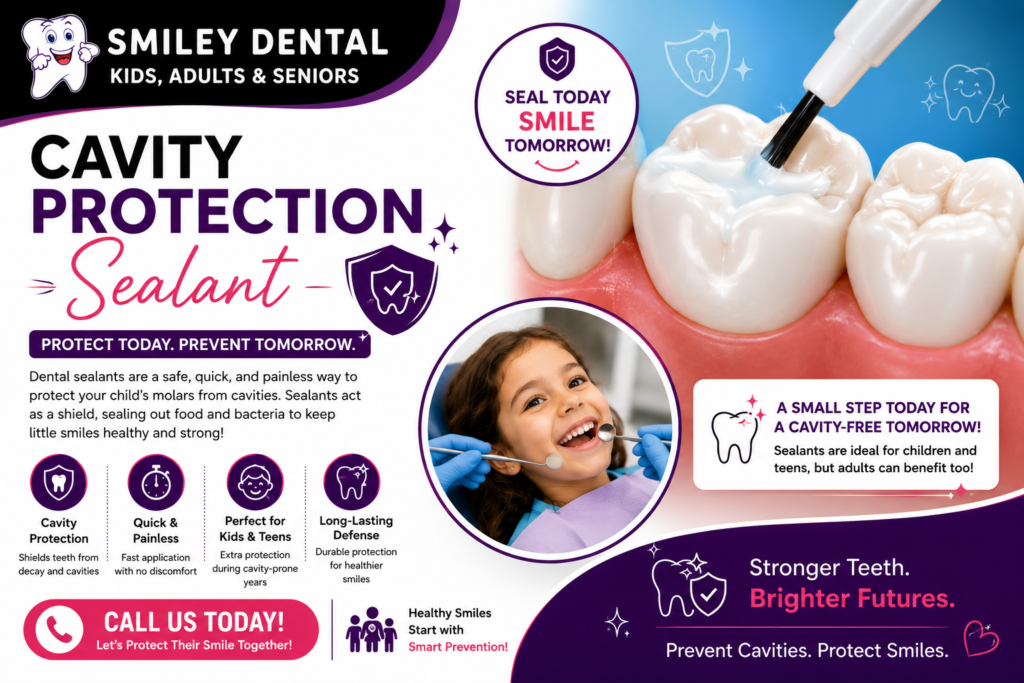
A dental sealant is a thin, tooth-colored resin coating applied to the chewing surface of a molar or premolar. Once it is painted on and hardened with a curing light, it forms a smooth, sealed barrier over the natural pits and grooves of the tooth. Food particles and bacteria can no longer settle into those tiny crevices, which is where a large share of cavities begin.
The process is quick, painless, and does not require any drilling or numbing. Most teeth can be sealed in just a few minutes, making it one of the simplest ways to add a real layer of decay protection to your smile.
Why Timing Really Matters for Dental Sealants
Sealants work best on a tooth that has not yet developed a cavity. Once decay has started, a sealant cannot reverse it, so getting ahead of the problem is the whole point. That is why dentists talk about specific windows of opportunity rather than a single fixed age.
Childhood: The Classic Sealant Window
The first permanent molars typically erupt around age 6, with the second molars following around age 12. Sealing these teeth soon after they come in gives protection before cavity-causing bacteria have a chance to settle in. For a deeper look at how this works for younger patients, our guide to dental sealants for kids breaks down the full process step by step.
Teens: A Second Round of Protection
Many families focus on sealants during early childhood and forget that second molars arrive later, usually between ages 11 and 13. These teeth are just as prone to deep grooves and just as easy to overlook during a busy teenage schedule, so a follow-up evaluation is worth scheduling.
Adults: A Second Chance, Not a Missed Opportunity
If you reached adulthood without sealants, or your childhood sealants have worn away, you have not missed your window. Any tooth with deep grooves and no existing decay or large filling is generally a good candidate, regardless of age.
Signs You (or Your Child) May Need a Cavity Protection Sealant Now
- Deep pits or grooves visible on the back teeth
- A history of cavities on molars, even with good brushing habits
- New permanent molars that recently erupted
- Dry mouth caused by medication, which reduces natural cavity protection
- Difficulty reaching back teeth thoroughly with a toothbrush
- An upcoming stretch of orthodontic treatment where brushing may become harder
Dental Sealants for Adults: A Closer Look
Dental sealants for adults are not a niche request. Adults with naturally deep grooves, a busy schedule that limits flossing consistency, or a history of decay on certain molars can all benefit from this added layer of protection. It is also a common add-on for patients starting orthodontic care, since brackets and aligners like Invisalign or traditional braces can make daily brushing more challenging for a while.
The procedure for adults is identical to the one used for children. There is no age cutoff written into the treatment itself, only a requirement that the tooth surface is clean and free of existing decay.
How the Cavity Protection Sealant Process Works
- Cleaning: The tooth is thoroughly cleaned to remove plaque and food debris.
- Preparation: A special etching gel is applied so the sealant bonds securely.
- Rinsing and drying: The gel is rinsed away and the tooth is dried completely.
- Application: The liquid sealant is painted onto the grooves of the tooth.
- Curing: A curing light hardens the material in seconds, completing the barrier.
Sealants vs Other Preventive Options
| Treatment | Best For | Typical Duration | Invasiveness |
|---|---|---|---|
| Cavity protection sealant | Deep grooves on molars and premolars | 5 to 10 years | None |
| Fluoride treatment | Strengthening enamel overall | A few months | None |
| Tooth-colored filling | Repairing existing decay | 7 to 10 years | Minor |
How Long Does Teeth Coating Protection Last?
With regular dental visits, a sealant can hold up well for 5 to 10 years, though wear varies from patient to patient depending on chewing habits and grinding.
| Timeframe | What to Expect |
|---|---|
| First 6 months | Sealant fully bonded, chewing surface feels smooth |
| 1 to 3 years | Routine checkups confirm the sealant is intact |
| 5 years | Some natural wear may appear, and touch-ups can be applied if needed |
| 8 to 10 years | Many sealants are still functional, though replacement is common by now |
Expert Dental Tips to Maximize Sealant Lifespan
- Avoid chewing ice or hard candy, which can chip the sealant edge.
- Keep up with twice-yearly cleanings so your dentist can check the sealant during routine visits.
- Mention teeth grinding to your dentist, since a night guard can protect both natural enamel and sealants.
- Continue flossing daily. Sealants protect chewing surfaces, not the spaces between teeth.
What Happens If You Wait Too Long?
Skipping preventive care does not mean nothing happens, it usually means a bigger repair later. A small cavity left untreated can progress deep enough to reach the tooth’s nerve, which is when patients typically need root canal treatment to save the tooth. After a root canal, many teeth also require a dental crown for long-term strength. In more advanced cases where a tooth cannot be saved, dental implants become the next step for replacing it. A cavity protection sealant is a small, simple way to avoid that entire chain of events.
Cost and Insurance Considerations
Sealants are one of the more affordable preventive treatments in dentistry, and many dental insurance plans cover them for children and teens at little to no out-of-pocket cost. Adult coverage varies more by plan, so it is worth confirming benefits ahead of your visit. Our team can walk you through your specific coverage before any treatment begins.
Sealants and Your Bigger Smile Goals
Protecting your teeth from decay is only one part of a healthy, confident smile. Once your preventive care is on track, some patients choose to explore professional teeth whitening for a brighter appearance, or porcelain veneers to address chips, gaps, or discoloration. Preventive treatments like sealants work hand in hand with cosmetic care, since a healthy foundation makes any cosmetic result last longer.
Protect Your Smile at the Right Time
Whether you are booking a first sealant for your child’s new molars or considering dental sealants for adults for the first time, timing is on your side more often than not. The sooner a vulnerable tooth is sealed, the less chance decay has to take hold.
Ready to find out if a cavity protection sealant is right for you or your family? Contact Smiley Dental Waltham to schedule your visit and let our team build a preventive care plan that keeps your smile strong for years to come.
Frequently Asked Questions
Everything you need to know about cavity protection sealants.